ADHD as an Energetic Dynamic
Rather than a disorder, ADHD can be viewed as a high-voltage, high-frequency system—requiring tuning, but capable of brilliance.
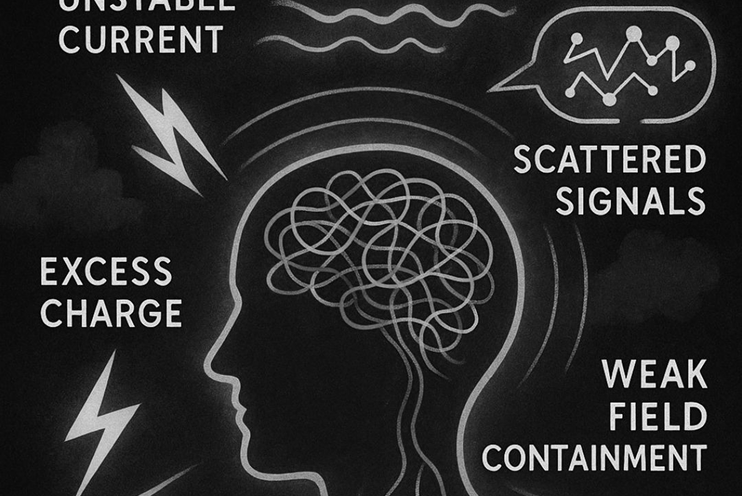
ADHD can be seen as a dysregulation in an individual’s internal electromagnetic field — a chaotic or unstable current flow. Attention flickers like an unstable frequency, and impulses jump erratically like electrical surges. Instead of a smooth, focused signal, the mind experiences noisy, scattered patterns, unable to maintain a steady circuit. Hyperactivity mirrors excess current with insufficient grounding, and distractibility reflects weak field containment, where external “signals” override internal focus.
In electromagnetic interpretation of classical ADHD symptoms, listed in DSM-5-TR, ADHD can be seen as an unstable circuit. The brain’s current is irregular, causing weak magnetic fields (poor focus) and noisy signals (distractibility). The comparator misfires (impulsivity), and executive circuits short out (disorganization, task-switching). External stimuli induce overload (hypersensitivity), while poor grounding leads to emotional surges (dysregulation). The system lacks coherence, flickers under pressure, and struggles to sustain stable energy flow.
The main symptoms and the Electro-Magnetic (EM) interpretation:
In this view, ADHD is not a deficit of attention but a misregulated energy system — one that needs better tuning, grounding, and channeling.
ADHD Symptoms (DSM-5-TR) with Electromagnetic Interpretations
Table of Symptoms (please, count the numbers of criteria, to help yourself with diagnostics) - see in the Google Doc Format -
https://docs.google.com/document/d/1nR48kmzAowfaYfSAcFdS2DQimZulDLdey0LEXVp4OCw/edit?usp=sharing
More detailed view of symptoms - decoding of each symptom:
ADHD as an Electromagnetic Disturbance
Here’s how ADHD can be interpreted using EM principles:
1. Irregular Neural Current (Signal Instability)
In a healthy brain, electrical impulses (action potentials) flow smoothly through circuits—like a well-regulated current through an electronic system. In ADHD:
🧠 Analogy: A light bulb flickering due to unstable voltage.
2. Weakened Magnetic Field (Low Attentional Cohesion)
Just as a steady electric current generates a stable magnetic field, a focused mind generates a strong “attentional field” that holds tasks and goals together. In ADHD:
📡 Analogy: A weak magnetic field that can’t hold iron filings in one shape.
3. Overloaded Comparator Circuit (Impulsivity)
The brain’s prefrontal cortex acts like a comparator—it evaluates options, delays responses, and regulates impulses. In ADHD:
⚠️ Analogy: A thermostat that can’t hold a set point and keeps switching erratically.
4. Short-Circuiting of Executive Function (Disorganization)
Executive function can be compared to a multi-branch electrical controller—routing power where needed. In ADHD:
🧩 Analogy: A power strip where the wrong device gets all the energy.
5. Hyper-reactive Induction (Sensory Overload)
In EM systems, nearby currents can induce voltage in adjacent circuits (parasitic induction). In ADHD:
🌪️ Analogy: A sensitive coil picking up interference from every passing signal.
6. Delayed or Weak Grounding (Poor Emotional Regulation)
In electrical terms, grounding discharges excess current. The ADHD brain:
Analogy: A circuit without proper grounding sparks under pressure.
⚡ ADHDers SUPERPOWERS
Rather than a disorder, ADHD can be viewed as a high-voltage, high-frequency system—requiring tuning, but capable of brilliance. The ADHD brain, though energetically “nonlinear,” often produces exceptional strengths when supported well. From an EM perspective, these strengths arise from the same qualities that cause challenges:
1. Creative Brilliance & Divergence: Field Multiplicity - Divergent Field Radiation
Like an unstable field generating multiple interference patterns, ADHD minds often think outside conventional pathways, generating novel ideas and solutions that others might overlook. ADHD brains generate ideas like charged particles radiating in all directions. They explore unconventional paths, leading to original art, inventions, and solutions.
2. Hyper-focus - Resonant Frequency Lock-in, High-Energy Spikes
When interest aligns with task, the current surges—creating intense, sustained focus and deep dives into complex subjects (art, science, design, coding). Passion aligns, attention becomes laser-focused—like a signal perfectly tuned to its resonant frequency. Hours can pass in deep, productive immersion, some call it Flow.
3. Rapid Problem-Solving & Fast Pattern Detection - Fast Signal Switching, Sensitive Induction
The ADHD brain is highly reactive to environmental input, like a super-sensitive coil—spotting connections, anomalies, or risks faster than typical systems. With quick jumps between thoughts (mental multithreading), ADHDers can connect distant concepts and think on their feet—ideal for crisis solving and improvisation.
4. Emotional Intensity & Empathy - High-Amplitude Waves
Their sensitivity makes them highly attuned to emotions - both their own and others’. This can fuel deep compassion, emotional honesty, and social insight. This can also lead to a "cold" attitude, as a defence mechanism to protect the inner sensitivity with external coldness.
5. Energetic Drive - High Voltage System
They carry internal energy like a powerful current—great for high-stakes environments, entrepreneurship, activism, or creative performance.
6. Spontaneity & Humour - Oscillating Current Playfulness & Super Flexible Flow
With energy constantly in motion, these individuals are agile thinkers, able to pivot and improvise quickly, thriving in dynamic, chaotic, or high-stakes environments. The mind naturally shifts gears—sparking playful thinking, wit, and joy. Many comedians, performers, and storytellers have this flowing spontaneity.
7. Sensitivity to Detail (in bursts) - High-Gain Amplification
Though they may miss mundane things, ADHDers can detect subtle signals others miss—especially in areas of personal interest.
8. Adaptability & Flexibility - Alternating Current (AC) Thinking
Their minds don’t get stuck—they’re flexible, fluid, and often thrive in chaos or change. This agility helps in innovation, learning, and survival.
9. Visionary Thinking - Multi-dimensional Field Awareness & Unfiltered Signal
Lacking strict inhibitory gates, ADHDers often radiate sincerity and originality, expressing themselves with unique voice and emotional depth. With minds attuned to patterns and connections, they often “zoom out” to see big pictures, trends, or future possibilities. Many are natural visionaries.
ADHD is not a "broken circuit"—it is a high-frequency system with expansive range. With the right regulation and support, these minds can light up the world.
🎨 FAMOUS ADHDers
No formal diagnosis can be made retroactively, but many ADHD specialists (e.g., Dr. Ned Hallowell, Dr. Gabor Maté) use these examples to illustrate the positive traits of ADHD. These figures are often highlighted in neurodiversity advocacy to reframe ADHD as a difference—not a deficit. Their divergent thinking, hyperfocus, and nonlinear processing led to groundbreaking discoveries and inventions. Here’s a list of some of the most well-known figures:
1. Thomas Edison – Inventor of the Light Bulb & Phonograph
Restless energy, dropped out of school, obsessed with experimenting. Edison was constantly tinkering, often working on multiple ideas at once—classic signs of hyperfocus and divergent attention.
2. Leonardo da Vinci – Polymath: Art, Engineering, Anatomy
Many unfinished projects, hyper-curious mind, intense shifts in interest. Da Vinci’s mind moved fluidly across disciplines, showing the same mental “jumping” and intuitive leaps common in ADHD.
3. Nikola Tesla – Electrical Pioneer (AC Current, Tesla Coil)
Vivid imagination, little need for sleep, sensory sensitivity. Tesla described visualising inventions fully before building them—an intense, internal high-frequency mental loop.
4. Albert Einstein – Physicist, Theory of Relativity
Late talker, poor memory for routine things, but hyperfocused on physics. Though speculative, his school struggles and obsession with abstract theory align with ADHD traits.
5. Michael Faraday – Father of Electromagnetism
No formal education, passionate autodidact, obsessive in lab work. Faraday’s conceptual leaps in fields and induction mirror the nonlinear, intuitive style of many ADHDers.
6. Richard Branson – Founder of Virgin Group (openly ADHD)
Diagnosed with ADHD and dyslexia, turned impulsivity into entrepreneurship. His risk-taking and visionary thinking helped build a business empire.
7. Dr. Edward Hallowell – Psychiatrist, Author of Driven to Distraction
Openly ADHD, revolutionised how ADHD is understood in modern psychology. He turned his own diagnosis into a source of scientific insight and advocacy.
✅ Confirmed ADHD diagnosis: Hallowell is not just an expert on ADHD—he lives with it and transformed it into a life mission.
8. Simone Biles – Olympic Gold Medalist (diagnosed ADHD)
Extreme energy, focus under pressure, and drive for excellence. Her ability to hyperfocus under performance stress shows the upside of ADHD energy channeled with support.
✅ Publicly confirmed diagnosis: Simone Biles is an open advocate for ADHD awareness and reducing stigma in elite performance.
ADHD doesn’t block greatness—it often fuels it. These individuals transformed the world not by suppressing their traits, but by harnessing them with purpose and passion.
⚖️ THERAPY
ADHD is not a deficit of attention. It is a surplus of untamed energy — a powerful current seeking resonance. Therapy must not suppress the current flow, but tune the frequency, ground the charge, and open the right channels.
Thanks to Energy-Oriented Psychotherapy which is based on the electromagnetic (EM) framework, ADHD can be seen not as a disorder, but as a dysregulated high-frequency system with immense potential. Therefore, therapy should focus not on suppressing the current, but on tuning, grounding, channeling, and regulating the energy flow.
ADHD Therapy & Healing Through EM Principles - Table
See the Table in Google Doc Format for more clear details - https://docs.google.com/document/d/16Fdnbuw_216YKED76CEea4UovGAbTez1ZtKfC7dYlMU/edit?usp=sharing
Therapy Targeting At Glance:
1. Circuit Grounding
Practices like breathwork, cold exposure, and nature immersion act as energetic grounding rods.
2. Signal Regulation & Modulation
Attention doesn’t need to be “normalized”—it needs to be entrained to sustainable rhythms.
3. Comparator Repair (Executive Function Training)
Use external supports (reminders, planners, delegations, helpers) to build artificial circuit stabilisers until internal regulation improves.
4. Field Coherence and Entrainment
ADHDers thrive when surrounded by coherent, resonant environments—not when fighting against rigid ones.
5. Channeling High Voltage into Purpose
The task is not to lower energy, but to build circuits strong enough to hold it.
6. Field Hygiene & Shielding
ADHDers have innate field-sensitive sensors. You need to keep the system clean, predictable, and attuned.
🤸♂️ ADHD CHILDREN EDUCATION
Children with ADHD thrive best in educational systems that are flexible, experiential, emotionally supportive, and movement-friendly. Traditional classroom models often clash with their neurodivergent wiring (e.g., long sitting, passive learning, rigid schedules). Below are educational systems ranked by suitability, based on how well they align with the ADHD brain’s energetic and attentional profile:
Best Educational Systems for Children with ADHD
1. Montessori Education
Child-led learning, hands-on activities, freedom of movement
2. Waldorf (Steiner) Education
Imaginative, rhythmic, movement-rich curriculum
3. Forest Schools / Outdoor Learning Models
Nature-based, physical, exploratory learning
4. Project-Based or Reggio Emilia Approach
Inquiry-driven, collaborative, and student-centered
5. Democratic or Sudbury Schools
Student decides what, when, and how to learn
🌈 Ideal Features for ADHD Education (regardless of system):
It is up to us, up to our generations to see ADHD as a problem and label it as a disease or to support and help the ADHD brain to adapt to the current world with necessary care and attention in the childhood period. The ADHD system needs more attention and patience, a non-standard educational environment, less hard demands and more freedom.
Rather than a disorder, ADHD can be viewed as a high-voltage, high-frequency system—requiring tuning, but capable of brilliance.
ADHD can be seen as a dysregulation in an individual’s internal electromagnetic field — a chaotic or unstable current flow. Attention flickers like an unstable frequency, and impulses jump erratically like electrical surges. Instead of a smooth, focused signal, the mind experiences noisy, scattered patterns, unable to maintain a steady circuit. Hyperactivity mirrors excess current with insufficient grounding, and distractibility reflects weak field containment, where external “signals” override internal focus.
In electromagnetic interpretation of classical ADHD symptoms, listed in DSM-5-TR, ADHD can be seen as an unstable circuit. The brain’s current is irregular, causing weak magnetic fields (poor focus) and noisy signals (distractibility). The comparator misfires (impulsivity), and executive circuits short out (disorganization, task-switching). External stimuli induce overload (hypersensitivity), while poor grounding leads to emotional surges (dysregulation). The system lacks coherence, flickers under pressure, and struggles to sustain stable energy flow.
The main symptoms and the Electro-Magnetic (EM) interpretation:
- Inattention = Poor signal regulation and weak field coherence
- Hyperactivity = Excess current with insufficient containment
- Impulsivity = Premature signal discharge due to bypassed control circuits
In this view, ADHD is not a deficit of attention but a misregulated energy system — one that needs better tuning, grounding, and channeling.
ADHD Symptoms (DSM-5-TR) with Electromagnetic Interpretations
Table of Symptoms (please, count the numbers of criteria, to help yourself with diagnostics) - see in the Google Doc Format -
https://docs.google.com/document/d/1nR48kmzAowfaYfSAcFdS2DQimZulDLdey0LEXVp4OCw/edit?usp=sharing
More detailed view of symptoms - decoding of each symptom:
ADHD as an Electromagnetic Disturbance
Here’s how ADHD can be interpreted using EM principles:
1. Irregular Neural Current (Signal Instability)
In a healthy brain, electrical impulses (action potentials) flow smoothly through circuits—like a well-regulated current through an electronic system. In ADHD:
- The neural current fluctuates irregularly.
- This results in signal noise, leading to difficulty sustaining attention, like a flickering signal in a poorly grounded circuit.
🧠 Analogy: A light bulb flickering due to unstable voltage.
2. Weakened Magnetic Field (Low Attentional Cohesion)
Just as a steady electric current generates a stable magnetic field, a focused mind generates a strong “attentional field” that holds tasks and goals together. In ADHD:
- The field is diffuse or scattered.
- Attention drifts, pulled by external “magnetic noise” (distractions).
📡 Analogy: A weak magnetic field that can’t hold iron filings in one shape.
3. Overloaded Comparator Circuit (Impulsivity)
The brain’s prefrontal cortex acts like a comparator—it evaluates options, delays responses, and regulates impulses. In ADHD:
- The comparator triggers prematurely or fails to inhibit.
- Impulses bypass control, like an overloaded Schmitt trigger firing too fast.
⚠️ Analogy: A thermostat that can’t hold a set point and keeps switching erratically.
4. Short-Circuiting of Executive Function (Disorganization)
Executive function can be compared to a multi-branch electrical controller—routing power where needed. In ADHD:
- The circuit often shorts out, misdirecting energy to low-priority tasks.
- This results in forgetfulness, task-switching, or hyperfocus on the wrong target.
🧩 Analogy: A power strip where the wrong device gets all the energy.
5. Hyper-reactive Induction (Sensory Overload)
In EM systems, nearby currents can induce voltage in adjacent circuits (parasitic induction). In ADHD:
- External stimuli induce excessive internal activation.
- The person becomes over-aroused, reactive, or distracted.
🌪️ Analogy: A sensitive coil picking up interference from every passing signal.
6. Delayed or Weak Grounding (Poor Emotional Regulation)
In electrical terms, grounding discharges excess current. The ADHD brain:
- Struggles to ground emotional energy.
- This leads to emotional outbursts, frustration, or dysregulation.
Analogy: A circuit without proper grounding sparks under pressure.
⚡ ADHDers SUPERPOWERS
Rather than a disorder, ADHD can be viewed as a high-voltage, high-frequency system—requiring tuning, but capable of brilliance. The ADHD brain, though energetically “nonlinear,” often produces exceptional strengths when supported well. From an EM perspective, these strengths arise from the same qualities that cause challenges:
1. Creative Brilliance & Divergence: Field Multiplicity - Divergent Field Radiation
Like an unstable field generating multiple interference patterns, ADHD minds often think outside conventional pathways, generating novel ideas and solutions that others might overlook. ADHD brains generate ideas like charged particles radiating in all directions. They explore unconventional paths, leading to original art, inventions, and solutions.
2. Hyper-focus - Resonant Frequency Lock-in, High-Energy Spikes
When interest aligns with task, the current surges—creating intense, sustained focus and deep dives into complex subjects (art, science, design, coding). Passion aligns, attention becomes laser-focused—like a signal perfectly tuned to its resonant frequency. Hours can pass in deep, productive immersion, some call it Flow.
3. Rapid Problem-Solving & Fast Pattern Detection - Fast Signal Switching, Sensitive Induction
The ADHD brain is highly reactive to environmental input, like a super-sensitive coil—spotting connections, anomalies, or risks faster than typical systems. With quick jumps between thoughts (mental multithreading), ADHDers can connect distant concepts and think on their feet—ideal for crisis solving and improvisation.
4. Emotional Intensity & Empathy - High-Amplitude Waves
Their sensitivity makes them highly attuned to emotions - both their own and others’. This can fuel deep compassion, emotional honesty, and social insight. This can also lead to a "cold" attitude, as a defence mechanism to protect the inner sensitivity with external coldness.
5. Energetic Drive - High Voltage System
They carry internal energy like a powerful current—great for high-stakes environments, entrepreneurship, activism, or creative performance.
6. Spontaneity & Humour - Oscillating Current Playfulness & Super Flexible Flow
With energy constantly in motion, these individuals are agile thinkers, able to pivot and improvise quickly, thriving in dynamic, chaotic, or high-stakes environments. The mind naturally shifts gears—sparking playful thinking, wit, and joy. Many comedians, performers, and storytellers have this flowing spontaneity.
7. Sensitivity to Detail (in bursts) - High-Gain Amplification
Though they may miss mundane things, ADHDers can detect subtle signals others miss—especially in areas of personal interest.
8. Adaptability & Flexibility - Alternating Current (AC) Thinking
Their minds don’t get stuck—they’re flexible, fluid, and often thrive in chaos or change. This agility helps in innovation, learning, and survival.
9. Visionary Thinking - Multi-dimensional Field Awareness & Unfiltered Signal
Lacking strict inhibitory gates, ADHDers often radiate sincerity and originality, expressing themselves with unique voice and emotional depth. With minds attuned to patterns and connections, they often “zoom out” to see big pictures, trends, or future possibilities. Many are natural visionaries.
ADHD is not a "broken circuit"—it is a high-frequency system with expansive range. With the right regulation and support, these minds can light up the world.
🎨 FAMOUS ADHDers
No formal diagnosis can be made retroactively, but many ADHD specialists (e.g., Dr. Ned Hallowell, Dr. Gabor Maté) use these examples to illustrate the positive traits of ADHD. These figures are often highlighted in neurodiversity advocacy to reframe ADHD as a difference—not a deficit. Their divergent thinking, hyperfocus, and nonlinear processing led to groundbreaking discoveries and inventions. Here’s a list of some of the most well-known figures:
1. Thomas Edison – Inventor of the Light Bulb & Phonograph
Restless energy, dropped out of school, obsessed with experimenting. Edison was constantly tinkering, often working on multiple ideas at once—classic signs of hyperfocus and divergent attention.
- Hallowell, E. & Ratey, J. (2011). Driven to Distraction (Revised).
- Discusses Edison as a likely ADHD case due to his early academic troubles, restlessness, and obsessive focus on invention.
- PBS Biography: Edison: A Mind on Fire
- Notes his nonlinear learning style and explosive creativity, common in ADHD.
2. Leonardo da Vinci – Polymath: Art, Engineering, Anatomy
Many unfinished projects, hyper-curious mind, intense shifts in interest. Da Vinci’s mind moved fluidly across disciplines, showing the same mental “jumping” and intuitive leaps common in ADHD.
- Isaacson, Walter. (2017). Leonardo da Vinci.
- A major biography pointing to traits like distractibility, hyperfocus, and idea-jumping—interpreted by some clinicians as ADHD-like.
- American Journal of Psychiatry commentary on neurodiversity in historical figures.
- Though not diagnosing, da Vinci is frequently cited in articles on neurodivergence.
3. Nikola Tesla – Electrical Pioneer (AC Current, Tesla Coil)
Vivid imagination, little need for sleep, sensory sensitivity. Tesla described visualising inventions fully before building them—an intense, internal high-frequency mental loop.
- Seifer, Marc J. (1998). Wizard: The Life and Times of Nikola Tesla.
- Documents Tesla’s intense focus, hallucination-like imagery, and irregular behavior—consistent with ADHD or other neurodivergence.
- Hallowell & Ratey again reference Tesla as an archetype of hyperfocused innovation with emotional intensity.
4. Albert Einstein – Physicist, Theory of Relativity
Late talker, poor memory for routine things, but hyperfocused on physics. Though speculative, his school struggles and obsession with abstract theory align with ADHD traits.
- Silverman, Linda Kreger (2002). Upside-Down Brilliance: The Visual-Spatial Learner.
- Discusses Einstein as a classic visual-spatial thinker, noting ADHD and giftedness overlap.
- Hallowell & Ratey – Delivered from Distraction
- Einstein is mentioned as an example of someone who likely had undiagnosed ADHD traits: slow to talk, disorganized, obsessive in specific interests.
- Smithsonian Magazine (2012):
- "The Truth About Einstein's Brain"
- Notes brain anatomy differences in regions associated with focus and visualization.
5. Michael Faraday – Father of Electromagnetism
No formal education, passionate autodidact, obsessive in lab work. Faraday’s conceptual leaps in fields and induction mirror the nonlinear, intuitive style of many ADHDers.
- Bence Jones – The Life and Letters of Faraday (1870)
- Faraday’s curiosity, focus, and preference for practical over theoretical learning mirror ADHD characteristics.
- Neurodiversity literature (e.g., books by Dr. Gabor Maté, Dr. Hallowell) frequently cite Faraday as a neurodivergent historical figure.
- Royal Institution Archives
- Letters and speeches reveal his nonlinear path and deep visual-spatial thinking.
6. Richard Branson – Founder of Virgin Group (openly ADHD)
Diagnosed with ADHD and dyslexia, turned impulsivity into entrepreneurship. His risk-taking and visionary thinking helped build a business empire.
- Richard Branson’s autobiography: Losing My Virginity (1998)
- He openly discusses his ADHD, dyslexia, and how they shaped his risk-taking style.
- ADDitude Magazine Interview:
- "I See ADHD as a Gift"
- First-person account of how ADHD became his entrepreneurial superpower.
7. Dr. Edward Hallowell – Psychiatrist, Author of Driven to Distraction
Openly ADHD, revolutionised how ADHD is understood in modern psychology. He turned his own diagnosis into a source of scientific insight and advocacy.
- Hallowell & Ratey – Driven to Distraction, Delivered from Distraction
- His own case is detailed in both books. He reframes ADHD as a "trait of champions."
- Interviews in Psychology Today, ADDitude Magazine, and TEDx Talks
- Publicly discusses his life with ADHD and how it fuels creativity, energy, and connection.
✅ Confirmed ADHD diagnosis: Hallowell is not just an expert on ADHD—he lives with it and transformed it into a life mission.
8. Simone Biles – Olympic Gold Medalist (diagnosed ADHD)
Extreme energy, focus under pressure, and drive for excellence. Her ability to hyperfocus under performance stress shows the upside of ADHD energy channeled with support.
- Simone Biles’ Twitter Statement (2016):
- “I have ADHD and I have taken medicine for it since I was a kid. Please know, I believe in clean sport.”
- The Washington Post, Time Magazine, The Guardian:
- Coverage of her 2016 medication disclosure and support for mental health and neurodiversity.
- ADDitude Magazine Profile:
- "Simone Biles: ADHD Champion"
- Explains how her diagnosis shaped her routines, focus, and resilience.
✅ Publicly confirmed diagnosis: Simone Biles is an open advocate for ADHD awareness and reducing stigma in elite performance.
ADHD doesn’t block greatness—it often fuels it. These individuals transformed the world not by suppressing their traits, but by harnessing them with purpose and passion.
⚖️ THERAPY
ADHD is not a deficit of attention. It is a surplus of untamed energy — a powerful current seeking resonance. Therapy must not suppress the current flow, but tune the frequency, ground the charge, and open the right channels.
Thanks to Energy-Oriented Psychotherapy which is based on the electromagnetic (EM) framework, ADHD can be seen not as a disorder, but as a dysregulated high-frequency system with immense potential. Therefore, therapy should focus not on suppressing the current, but on tuning, grounding, channeling, and regulating the energy flow.
ADHD Therapy & Healing Through EM Principles - Table
See the Table in Google Doc Format for more clear details - https://docs.google.com/document/d/16Fdnbuw_216YKED76CEea4UovGAbTez1ZtKfC7dYlMU/edit?usp=sharing
Therapy Targeting At Glance:
1. Circuit Grounding
Practices like breathwork, cold exposure, and nature immersion act as energetic grounding rods.
2. Signal Regulation & Modulation
Attention doesn’t need to be “normalized”—it needs to be entrained to sustainable rhythms.
3. Comparator Repair (Executive Function Training)
Use external supports (reminders, planners, delegations, helpers) to build artificial circuit stabilisers until internal regulation improves.
4. Field Coherence and Entrainment
ADHDers thrive when surrounded by coherent, resonant environments—not when fighting against rigid ones.
5. Channeling High Voltage into Purpose
The task is not to lower energy, but to build circuits strong enough to hold it.
6. Field Hygiene & Shielding
ADHDers have innate field-sensitive sensors. You need to keep the system clean, predictable, and attuned.
🤸♂️ ADHD CHILDREN EDUCATION
Children with ADHD thrive best in educational systems that are flexible, experiential, emotionally supportive, and movement-friendly. Traditional classroom models often clash with their neurodivergent wiring (e.g., long sitting, passive learning, rigid schedules). Below are educational systems ranked by suitability, based on how well they align with the ADHD brain’s energetic and attentional profile:
Best Educational Systems for Children with ADHD
1. Montessori Education
Child-led learning, hands-on activities, freedom of movement
- Allows for exploration and self-paced learning
- Multi-sensory, structured environments reduce chaos
- Less pressure, more engagement
- ✅ Excellent for focus, autonomy, and emotional development
2. Waldorf (Steiner) Education
Imaginative, rhythmic, movement-rich curriculum
- Emphasizes storytelling, art, and nature
- Daily rhythm helps regulate energy
- Strong emotional and relational component
- ✅ Great for creativity, grounding, and emotional support
3. Forest Schools / Outdoor Learning Models
Nature-based, physical, exploratory learning
- Frequent movement and sensory stimulation
- Reduces overstimulation from noise/crowds
- Builds self-regulation through natural challenges
- ✅ Ideal for kinetic learners and energy regulation
4. Project-Based or Reggio Emilia Approach
Inquiry-driven, collaborative, and student-centered
- Encourages focus through passion-based learning
- Supports curiosity and flexible attention
- ✅ Works well for highly curious, inventive ADHD minds
5. Democratic or Sudbury Schools
Student decides what, when, and how to learn
- Maximum autonomy and responsibility
- Suits independent thinkers
- ✅ Powerful for self-motivated ADHD learners—but requires maturity
🌈 Ideal Features for ADHD Education (regardless of system):
- 💡 Short, engaging lessons (chunked time)
- 🧠 Multi-sensory, hands-on tasks
- 🎨 Creative, open-ended assignments
- 🤸♂️ Frequent movement breaks
- ❤️ Strong teacher-student connection
- 🔁 Repetition through rhythm, not drilling
- 🧘 Emotional regulation and mindfulness components
It is up to us, up to our generations to see ADHD as a problem and label it as a disease or to support and help the ADHD brain to adapt to the current world with necessary care and attention in the childhood period. The ADHD system needs more attention and patience, a non-standard educational environment, less hard demands and more freedom.